

Grade 7 and up · Ages 12+
Seventh+ graders are rarely all operating at the same level, but a build everyone can finish, with a question anyone can test, is one of the few things that reaches all of them. These three kits do just that.
$5.13
lowest cost per student
60-90 min
activity time
01
Energy conversion · physics
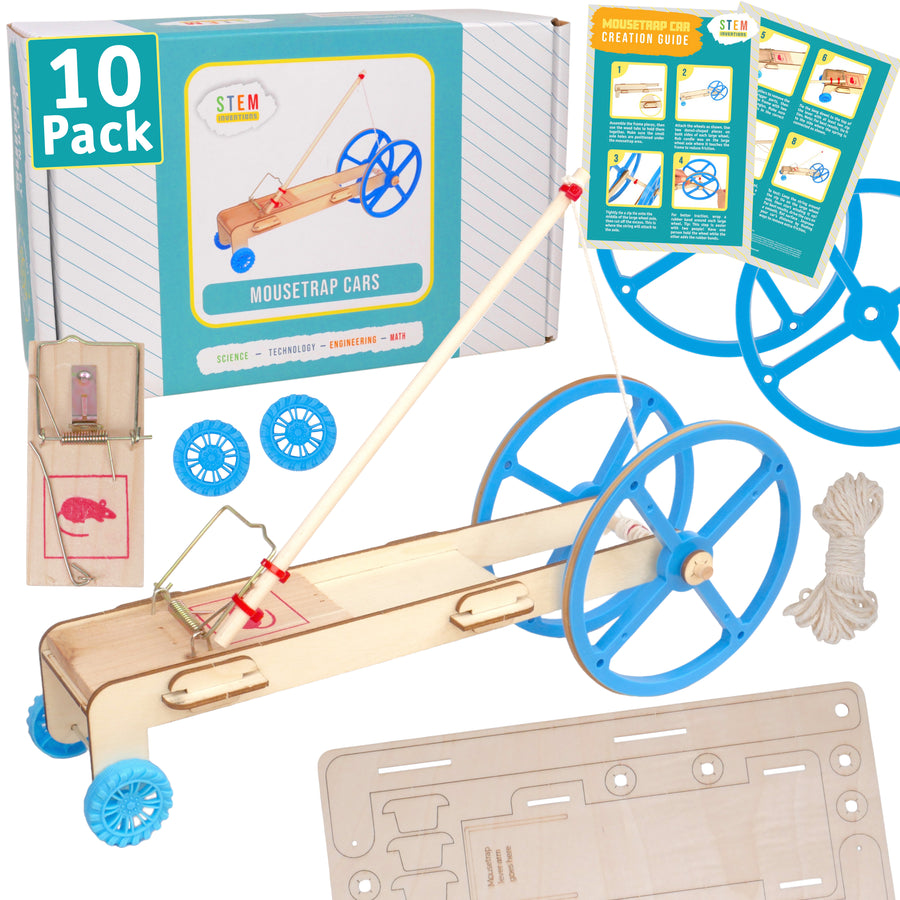
Mousetrap Cars
- A mousetrap spring pulls a string wound around the axle, turning stored energy into motion.
- Optimize for distance by removing friction and improving mechanical efficiency.
- A proven science fair and Science Olympiad build with enough depth for data collection and graphing.
Why it fits seventh grade and up
- Students at this age are better at identifying subtle improvements and optimizing their design.
- Students can predict the distance using math: string length times wheel diameter divided by axle diameter. Measuring the actual run and explaining the gap is the real lesson.
- The work transfers straight to science fair and Science Olympiad entries.
$51.26
$56.95
Builds 10 mousetrap cars
Price per student: $5.13
Pack size
02
Simple circuits · robotics
Wonky Robot Kit
- Students build a motorized robot-styled machine using special high-power motors.
- Combine different wheel attachments to change the driving pattern.
- See frequency and patterns in a delightful robot-styled design.
Why it fits seventh grade and up
- Jumper-style wire connectors let students build the circuit themselves and experiment with reversing the current.
- Students can measure frequency by counting the number of oscillations per rotation.
- Students can take on more challenging investigations, such as finding the best wheel combinations for overcoming obstacles.
$43.16
$47.95
Builds 10 robots
Price per student: $4.32
Pack size


03
Renewable energy · vehicles
Solar Powered Cars
- A solar cell drives a motor and gear train, so the car runs only on sunlight.
- Angle of the light source, light intensity, and driving surface affect performance.
- A classic project for demonstrating renewable energy.
Why it fits seventh grade and up
- Subtle differences in light intensity and angle can create measurable differences in speed.
- One clear variable means students can design and carry out a focused investigation independently, without step-by-step direction.
- The car runs as long as there's strong light, so students measure sustained speed rather than one-shot distance. That is a different kind of data than the other two kits produce.
$60.26
$66.95
Builds 10 solar cars
Price per student: $6.03
Pack size
Run all three as a unit on energy conversion
Pack sizes differ between kits, so check the student count on each one before ordering for a full class.
All three kits, one of each
$154.68
$171.85
POs accepted. Free shipping.